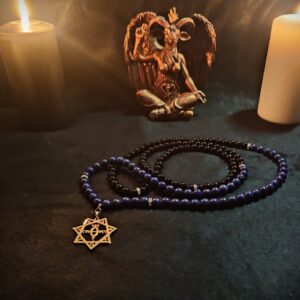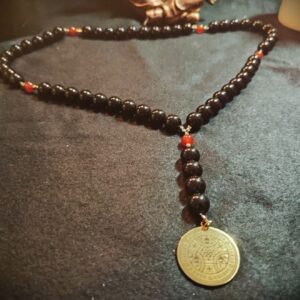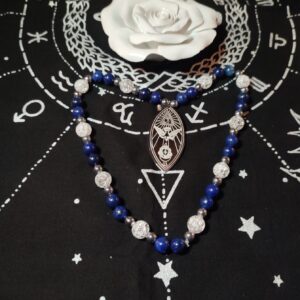
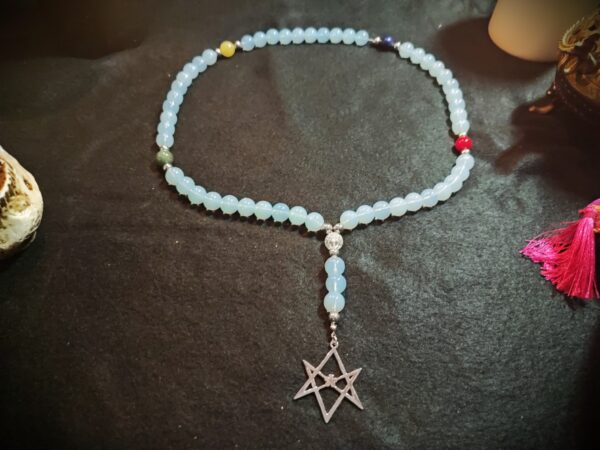
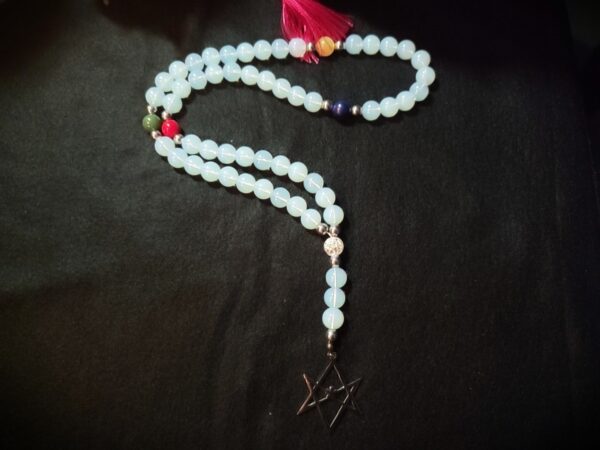
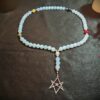

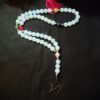
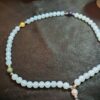
An exceptional prayer bead related to the Hermetic Golden Dawn tradition within the context of the Neophyte’s Degree (0°=0°), and it can be used for several exercises and practices using the formula: The Adoration of the Lord of the Universe. It has been intended for:
1. General Preliminary Invocations (Establishing the Sacred Space)
2. Initiation and Self-Consecration Rites
3. Consecration of Magical Tools and Talismans
4. Daily Devotions and Attunements
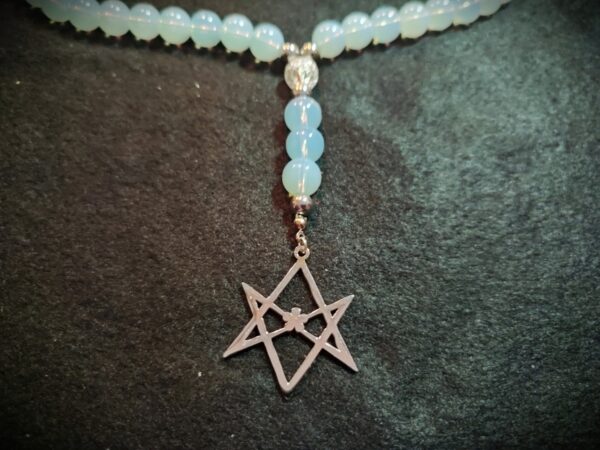
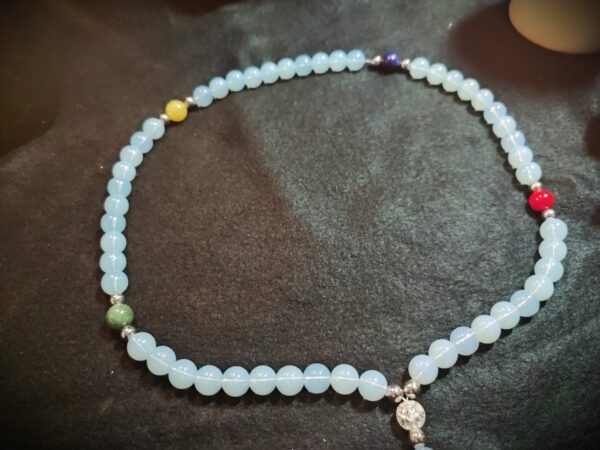
The prayer beads are made of white jadeite, representing the divine influx, and four decade separators: green aventurine, red dyed tridacna, yellow jadeite, and lapis lazuli, representing the four elements. As a pendant: an Unicursal Hexagram, which Giordano Bruno called Figura Amoris (1588, Prague book Essays upon the Mathematics of Mordente – Articuli adversus mathematicos). It was incorporated into advanced curricula, specifically within the Inner Golden Dawn’s Order (Rosae Rubeae et Aureae Crucis) for invoking and banishing planetary forces.
Eventually, Aleister Crowley, as a Golden Dawn’s Adept, modified the aesthetics by placing a five-petaled rose (or a small pentagram) directly at the center of the hexagram, meaning: the Union of Microcosm and Macrocosm. In occultism, the 5-pointed pentagram represents the Microcosm (man, the five elements, the earthly self). The 6-pointed hexagram represents the Macrocosm (the divine, the cosmos, planetary forces). By interweaving the rose with the unicursal star, Crowley visually represented the Great Work: the complete union of the human self with the divine universe.
The Magical Number 11
Mathematically, Crowley noted that adding the 6 points of the hexagram to the 5 petals of the central rose equals 11. In Crowley’s system, 11 is the premier number of divine union, magic, and the eleven sephirot of the Tree of Life.
“The Rose is the Heart, and the Hexagram is the Mind…”
Length: 98 cms + 13 cms at the drop, including the pendant.